

Our Strategy to 2035
Place to belong
Our Strategy to 2035 will help us keep the focus on what we do best - giving young people a place to belong and giving them the skills to thrive.
Find out more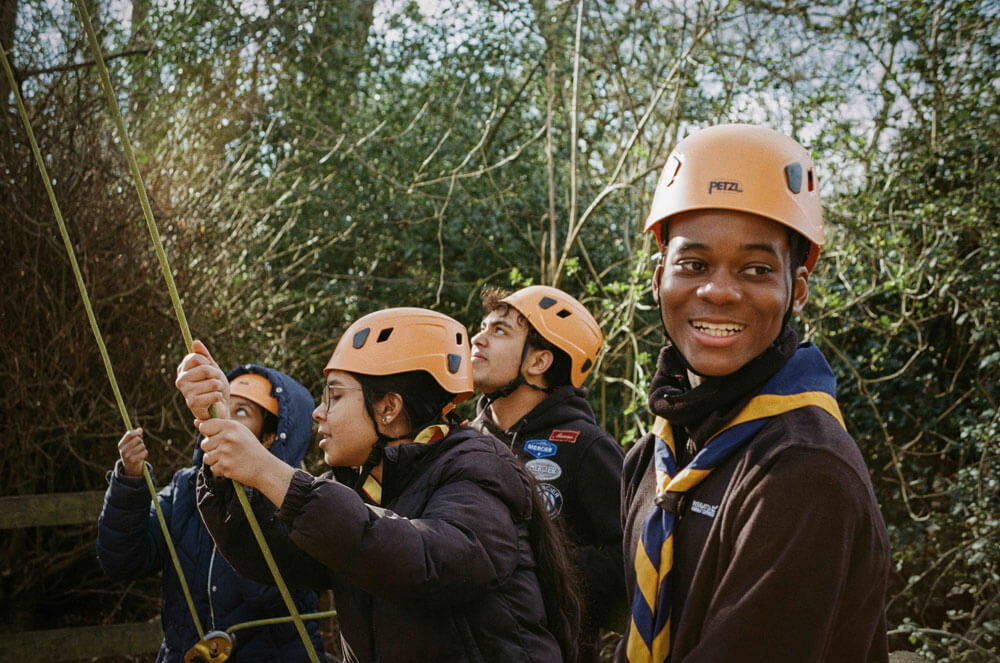
Note: The following has been prepared from an article that appeared in the 1957 Hendon Local Association booklet that marked 50 years of Scouting. It was prepared at their invitation by Frank Griffiths, assisted by Lionel Siret and Jack Le Fort.
In February 1909 a demonstration by the 1st, 2nd and 3rd Finchley Scout Troops was given before a distinguished Hendon audience at the Drill Hall, Algernon Road, and as a result the 1st Hendon BP Scout Troop was formed under Mr A R Turnbull of Audley Road. His stay was very short and Mr F Jennens of Victoria Road, Mill Hill, took over in August of that year, assisted by Mr Inglis and Mr G Manners Barrett. Mr Barrett was subsequently to be the first District Commissioner under the newly formed Hendon Local Association in 1920.
Later there was ‘a storm in a teacup’ caused by the formation of the 1st Central Hendon Troop. A letter to the editor of the ‘Hendon and Finchley Times’ from the secretary of the Finchley and Hendon Scout Committee stated that this group was entirely unauthorised and had no official connection with General Baden-Powell’s well known movement. The group was subsequently amalgamated with the 1st Hendon Troop.
In searching for headquarters, Mr Jennens, the first warranted Hendon Scouter, was fortunate in securing the use of an old barn on land belonging to Mr Booth in Colindeep Lane near the Silkstream. Here ‘BP’ paid many informal visits and on one occasion spent the whole weekend with the boys. Other good friends of the Troop were the Officers of the Middlesex Regiment at Mill Hill Barracks who were always willing to help the Scouts with the loan of tents and equipment for their weekend camps.
With the development of aviation the 1st Hendon Troop was on duty at the aerodrome each weekend and Scoutmaster Jennens recalls many flights with the intrepid pilots of those pioneering days. Claude Grahame-White was so impressed with the Troop that he became its President.
Prior to the start of the First World War the 1st Hendon changed its character, amalgamating with the Hampstead Sea Scouts, who operated on the Welsh Harp and had as their headquarters the Old Fire Station at the junction of Wilberforce Road and Station Road.
The 1st later ceased to be active as a separate Troop.
In August 1914 the 2nd Hendon Boys Life Brigade decided to become Scouts and were given the title 5th Hendon & Finchley (1st Hendon). Their Scoutmaster was Mr A E Rush, assisted by Mr L C Pike, and they were sponsored by the Finchley Lane Baptist Church. They were known as the ‘Yellow Boys’ on account of their gold coloured scarf. As the Victoria Hall was used as a Service Canteen the Scouts used the Old Fire Station in Brampton Grove as their home.
Following the war there was a resurgence in Scouting but in 1921 the Troop broke up, possibly because of its large numbers and also the wide membership area. A year or so ago a number of its members linked with the new 2nd Hendon. Later, other members went to the Congregational Church in Brent Street to form a new Troop; other boys under Percy Franklin linked with the 1st West Hendon Troop, which had been started at West Hendon Free Church in the Broadway under A J Martin.
Eventually the sponsoring body of the 1st Hendon Troop decided to revert to a Boys’ Brigade Company. The remaining keen Scouts went to the Congregational Church Troop which was registered as the 15th Hendon, later to the 7th Hendon (until 1931). Its Scouters included Messrs Cherry, Tanner, Griffiths and Medina.
———————
According to the District Directory for Hendon, dated June 1965, there was a 1st Hendon Group that met in Market Lane, Burnt Oak, Edgware (off Watling Avenue). There is probably no connection with the Group mentioned above with the scarf colour being Scout green with a white border. The GSM/SM was R Kunzie and the CM was Mrs L Silvester.
——————–
Our Strategy to 2035
Our Strategy to 2035 will help us keep the focus on what we do best - giving young people a place to belong and giving them the skills to thrive.
Find out more